Wednesday, March 12, 2014

Malaysian Flight 370 - Time to ask different questions


At first glance this story didn’t look like something I had anything to contribute to. Sure the disappearance of Malaysian Flight 370 seemed mysterious, but plane crashes over the ocean often are. However, more details keep coming out that just can’t be ignored. Often times tracking the misinformation will bring you closer to the truth than attempting to piece together the murky details.


Take for instance the two Iranians who had boarded the plane with stolen passports. Look how quickly Interpol shot down the possibility that this was a terrorist attack. Apparently, they “didn’t have criminal backgrounds” and were “most probably seeking asylum in Europe.”
Reports came out that relatives were waiting for them on the ground in Europe. iranians flight path.jpg


Now this is funny. Rather than take a more direct path (which is what you would expect for people traveling on a stolen passport) these two Iranians traveled to Qatar under their actual identities. From Qatar (still under their true identities) they went completely in the opposite direction to Malaysia. In Kuala Lumpur they would switch out passports and board flight 370 to Beijing. Wait...I thought they were on their way to Western Europe?
It looks even more ridiculous when you look at it on a map (above). The blue box shows where their supposed final destination is. The red line shows their actual movements.
Two Iranians, traveling on false travel documents, and Interpol says they were seeking asylum in Western Europe. Misinformation.


So what do we know that is fact?
1. The Boeing 777 took off from Kuala Lumpur at 12:41am.
2. The flight was to travel 2,700 miles to Beijing, China.
3. At 1:30am flight traffic control lost traffic of the plane over the South China Sea.


That’s the end of fact. No one’s getting any real answers because everyone is chasing the same leads.


Aviation experts have gone on record saying that the sudden disappearance and lack of communication from the airplane suggest “something we’ve never seen before”. A sudden explosion from either technical malfunction or a terrorist attack would have left massive debris, oil, etc in the general vicinity of where the last known location was.


So what happened?


A Boeing 777 is one of the most technologically advanced passenger planes to ever be put up into the sky. That may have been it’s achilles heel. We live in an era of high technology and cyber warfare. In 2008 Wired magazine did a story on the vulnerability to passenger airlines to cyber attack. They specifically mentioned Boeing aircraft.


This is just a small example of the possibilities. It also illustrates a growing cyber warfare arms race. One that has been intensifying in the South and East China Seas more specifically. Last May,The New York Times did a story on China’s growing cyber warfare capability.
The Chinese are rapidly trying to play catch up in their periphery. It’ll take at least a decade to match the U.S. Navy in the Pacific theater. They can however attempt to counter American assets unconventionally. Cyber warfare is the new battleground. China’s only chance at the moment is to neutralize U.S. drones, planes, and missiles with their cyber warfare program.


So what’s the point here? Remember Korean Airlines Flight 007?


We’re way past the days of scrambling fighter jets to shoot down civilian aircraft. That type of incident would never cut it in this day of mass and instant media.The political blowback would be nuclear.
I’m not saying this happened, but the possibility that this was a cyber attack is possible. It may seem far fetched, but the misinformation regarding the two Iranians tells us that there is something more here. I don’t think a Chinese move such as this could occur completely unilaterally. There would have to be something here to justify to other governments the need to do this.


In November of last year a report came out that showed Tehran and Pyongyang have been covertly collaborating to construct an 80 ton rocket that can be used in both countries ICBM program. For the most part, China has been looking the other way. However, on March 3rd North Korea conducted a missile launch that endangered a Chinese passenger plane. The plane passed through the trajectory of the missile.
Just 3 days later China would make the most overt statement toward North Korea than we’ve seen in awhile.
http://www.reuters.com/article/2014/03/08/us-korea-north-china-idUSBREA2703Q20140308


"The Korean peninsula is right on China's doorstep. We have a red line, that is, we will not allow war or instability on the Korean peninsula," Chinese Foreign Minister Wang Yi told reporters at a news conference for the National People's Congress in Beijing. Wang would go on to say that peace could only be obtained via denuclearization.


1 day after the Chinese government draws their “red line” Flight 370 disappears.


It’s possible the two Iranians on board flight 370 were traveling to Beijing to catch the train into North Korea. If you’re traveling to North Korea the road starts in Beijing. Could these two Iranians been a part of the Tehran/Pyongyang ICBM collaboration?


If the Chinese government used a cyber attack to disable Flight 370 how long would the Boeing 777 have coasted under radar levels before it eventually hit the ocean? This would explain why all electronic contact with the airplane completely stopped. An explosion would have left wreckage at the last known contact spot. There would be evidence. However, a sudden catastrophic loss of power would have rendered all the aircrafts systems unresponsive. She would have glided well beyond where she was reported to be.


Again, I’m not saying this is what happened, but all the elements are there to ask the question. It’s a dramatic statement made toward North Korea to back off. As the Soviet Union showed us in 1983, this type of response is well within play. It’s also a move that the U.S. and the rest of the west wouldn’t pursue too heavily. Strategic goals align...and geopolitics is a cold business.

Wednesday, March 5, 2014

Ukraine, Crimea, Russia - What do we do?


The more I watch the media coverage on Ukraine, Crimea, and Russia the more irritated I am on what’s being said. More importantly, however,  is what’s not being said. No one is talking about what the long term repercussions of Russia’s actions are for the entire “World Island”.


Putin appears to be advocating an extremely dangerous foreign policy. He’s saying that ethnic identification is more important than citizenship.


In Putin’s mind if there’s a high ethnic population in a foreign country that gives the right to militarily annex territory from a sovereign nation. This foreign policy was on display in the invasion of Georgia in 2008 and now currently in Ukraine.


Be very careful with the box you’re opening up here Mr Putin. You’re stoking the flames of nationalism in an area that has seen this type of behavior before. Europe is already seeing the rise of several far right groups. The situation in Crimea has the ability to create an ethnic ripple that could reach both great oceans.
How long before the Chinese use this as a basis to annex parts of eastern Russia? The number of Han Chinese along Russia’s eastern border grows every year. How long before Azerbaijan uses their high number of ethnic Azeris inside Iran? What about the high amount of ethnic Hungarians in Romania? As history has shown all it takes is one charismatic leader to stoke the fascist flames.


No one seems too keen on providing the public with actual options. How can we as citizens demand any kind of action from our elected officials if we don’t understand what needs to be done? Quit with the clever catch phrases like “It’s a new Cold War” or “Putin out maneuvers the west” etc.


Well….what should the U.S./Western response be?


First of all Russia needs to be expelled from the G8 immediately. How they got in at all was a complete mystery. There’s nothing complex or dynamic with their economy. It’s a fossil fuel export driven cartel...that’s about it. Immediately offer the vacant space to China. This would send not only Russia a message but also to China as well. Reading between the lines China would know that their G8 membership could be stripped if their aggression in the East and South China Seas get out of control.
Second, the United States needs to increase their military footprint in NATO countries. Nothing major that would constitute a buildup on Russian borders. Just enough to show the eastern European countries that we’re committed to their security.
Third, the U.S. needs to immediately approve natural gas exports to western European allies, NATO members, and other countries Russia threatens with their energy monopoly. This would help to take away Moscow’s natural gas trump card, and buy some time for the southern gas corridor pipelines to be built (roughly in 2018).


Remember that having Putin so focussed on his periphery is a very good thing. I laugh when I hear people claim that Putin outmaneuvered the west on this. How? Besides the fact that Russia lost Ukraine the biggest loss is that he woke the United State’s up in an area he thought was secure. Putin was so comfortable with the state of affairs in the countries along his borders that he got greedy and began to meddle elsewhere. Iran, Syria, Egypt...all areas he was able to engage in with the stability of his periphery. Now he can’t devote so much attention there anymore.
If I’m John Kerry I’m advising the President to keep Putin focused on Ukraine, Georgia, Moldova, Belarus, etc. Don’t let the heat on this cool. While Putin’s eye is focused here we can go back to work elsewhere.

Russia is not a global superpower. They are however a strong regional power. The down side of a regional power trying to exert themselves throughout the globe is that they get over extended. This is what’s happening currently to Putin and why he’s currently on the defensive….not offensive.

Monday, March 3, 2014

Ukraine, Crimea, Russia...Monday morning thoughts


The hard reality is that Ukraine has next to no strategic value for the United States. We’re no longer in the business of stopping the spread of communism. That mission is dead. The only value of Ukraine for the west is that it helps to solidify a stronger Central Europe that checks the power of both Western Europe and Russia. Similar to how the map looked pre-WW1. It goes right along with the recent defense cuts proposed by Chuck Hagel. The new strategy is disengagement.  In order to disengage we must first ensure that there are adequate regional power checks.
On the other hand, Ukraine is a significant strategic priority for Moscow. The majority of European natural gas runs straight through Ukraine. Russia’s economic survival hinges on ensuring fossil fuels continue running through Ukraine’s borders. The references to the Cold War are humorous. We’re now in a Fossil Fuel War. Whomever controls the flow of energy controls the world. Moscow is fighting for Ukraine to ensure that they control the flow of energy into Western Europe.
Fortunately for Moscow all the cards are in their favor. No matter how much support the west gives to pro democracy NGO’s the economic realities will not change. Ukraine has an energy and economic problem. The U.S. and the EU can’t solve it for them. Russia can. All Moscow has to do is sit back and let panic set in. The struggling EU simply can’t write the checks that Kiev needs. The harsh realities of the Russian Georgian invasion of 2008 are the same today. The U.S. can’t intervene to protect nations in Russia’s periphery. Russia invaded South Ossetia and we couldn’t stop them. If they invade Crimea the result would be similar.
The answer:
If Ukraine has no strategic value for the U.S. but is important to Russia than what is the purpose? This is a distraction. Plain and simple. Russia has increased their presence on the world stage over the past couple of years. Iran, Syria, Snowden, and then the arms deal with Egypt was the last straw.
For years Russia has capitalized on the United State’s preoccupation with the middle east. They’ve used that to regain the ground they lost in their near abroad since the collapse of the Soviet Union. Putin felt comfortable with his periphery. Belarus was as close an ally as ever, Kazakhstan, Ukraine with Yanukovich, etc. He started to move beyond his near abroad into Iran, Syria, Egypt….into territory claimed by the U.S. comfortably for the past 50 years.
The arms deal with Egypt was the last straw. The Maidan protests in Ukraine would step up their game and begin to occupy government buildings. Yanukovich’s governemt fell. At the same time the Obama Administration scheduled high level meetings with the foreign ministers of both Moldova and Georgia. The strategy is obvious….mess in our backyard and we’ll snoop around in yours. Putin can no longer devote his attention outside his region (Syria, Venezuela, Egypt, Iran). He has to police his own neighborhood.
The lesson is learned: this is the difference between a Superpower and a Regional power.
If Moscow is busy dealing with Ukraine/Moldova/Georgia they’re not concentrating on supplying Assad with surface to air missiles. They’re not concentrating on being the major supplier of arms to the greater middle east. They’re not concerned with supporting Iran….etc.
The strategic significance of Ukraine to the U.S. is that it’s a major distraction for Russia...and that’s all.


What happens next:


Putin chose Crimea as his answer to Maidan. Eastern Ukraine is thick with ethnic Russians but Crimea is about 60% ethnic Russian. If Putin is anything like his 2008 self he’ll invade Crimea in order to “protect ethnic Russians” just like he did in South Ossetia in Georgia. Just as in 2008 the message will be clear. The U.S. can’t stop Russia from influencing their near abroad.
It’s a hard truth. Ukraine is destined to be caught in the middle between Russia and the west. Central Europeans in the west and ethnic Russians in the east. The only thing that will help to free Ukraine from Russia’s influence is natural gas from the southern gas corridor. Oil/gas from the middle east to compete with Russian oil/gas will help Ukraine break free. Until those pipelines are completed Russia will continue to control the flow of energy into western Europe and will thus keep their foot on the neck of Ukraine.
The Crimean conflict will rest squarely on the shoulders of the Ukrainian military. The U.S. and NATO will not directly engage Russian forces. My guess is that the U.S. and the EU are urging restraint. An overly forceful response by the Ukrainian military is exactly what Putin is waiting for. That’s what green lit him in Georgia in 2008.
The U.S. doesn’t necessarily want this resolved too quickly. It’s a much needed distraction for Vladimir Putin.
A strong answer to Snowden, Egypt, Syria...etc. Regardless of how this is spinned. It shows that Moscow over extended itself and is now paying the price.

Wednesday, February 26, 2014

Crimea - Barometer for eastern Ukraine


Reuters posted a video today that showed two rival protest groups clashing in the Crimean administrative capital of Simferopol.
link:

The rhetoric coming from Moscow is worrisome. The Russian Foreign Ministry stated that the protesters were “extremists” and that foreign governments were “imposing their will”. The rhetoric is even more significant as President Putin ordered a readiness test of Russian troops along the western border putting them on high alert.

History shows how Putin has responded to these situations in the past. In 2008 Putin threatened Georgia that if Russian citizens were threatened he would step in to defend them. The autonomous South Ossetia would be invaded and the short Russia/Georgian War would end with considerable casualties. Russian troops remain in South Ossetia to this day.

Crimea is over 60% Russian and holds a major Naval port for Russia’s Black Sea Fleet. If Putin uses similar rhetoric as he did in 2008 it’s highly possible he could  invade Crimea to “defend Russian citizens” and Russian property (Black Sea Fleet Naval facilities). Similar rhetoric could also be used to justify the invasion of the other eastern provinces that have a high amount of ethnic Russians.

Georgia - John Kerry meets with Georgian Prime Minister


John Kerry kicks off a series of meetings today for the U.S. with Georgian Prime Minister Irakli Garibashvili. Later in the week President Obama and Vice President Biden will also take meetings with the Georgian Prime Minister.
See the Department of State press release here:
http://www.state.gov/r/pa/prs/ps/2014/02/222546.htm

The timing of this meeting is very interesting but not at all surprising. Washington is looking to capitalize on the Ukrainian success and push on other countries in Russia's near abroad. You can bet that western backed pro democracy NGO's (the thorn in Putin's side) will be a major topic of discussion. Leveraging their gains in Ukraine will be critical in these early stages.

Look for more of these higher level meetings to take place elsewhere in Russia's periphery. Belarus and Moldova are sure to see similar treatment. Turning up the heat on Moscow appears to be in full swing for the Obama Administration. It's not surprising seeing as how aggressive Russia has been lately in the Middle East.

Keep an eye on how Russia responds. A good case can made that Russia was pushed to invade Georgia back in 2008 as a response to these populist uprisings. Putin feared the epidemic within his own borders and felt he had to make a statement. Invading Georgia showed the region that Washington couldn't protect them. Now in Ukraine the appearance is that Russia could not intervene to stop the populist uprisings. How will Moscow respond this time?

Tuesday, February 25, 2014

Qatar - The United States’ Main Priority in the Middle East


Before saying anything I want the reader to remember one all encompassing point. If you get confused or lose track with anything in the following article go back and reference the next statement. Everything that happens in the Middle East revolves around energy.

Ok, now that we’ve got that out of the way…


Ever since the Arab Spring kicked off in December of 2010 I’ve been curiously following the Muslim Brotherhood. That obviously got me very interested in the Egyptian Revolution of 2011 and I looked on in amazement as the Muslim Brotherhood candidate Mohammed Morsi became President. The most interesting thing for me was how The United States and the Arab media dominated by Al Jazeera backed this new regime so intently.
Almost every Middle Eastern nation has an outright ban on the Muslim Brotherhood. The Muslim Brotherhood infiltrates a nation from the inside, incites populist uprisings, and attempts to topple governments. Egypt was their crowning achievement. So why is Qatar, who runs the Al Jazeera news network, the only nation in the Middle East not scared of the Muslim Brotherhood? Why was the United States so fully committed to Morsi’s government? It seems more evident as time goes by that the Muslim Brotherhood is a geopolitical tool being used by The United States and Qatar.

Why Qatar? Calling Qatar a country is a bit of a stretch. With a population of around 1.8 million only 250,000 of these are actual citizens. Citizens pay zero income tax and enjoy the highest per capita GDP in the world at 106,000. Qatar is an absolute monarchy ruled by the Al Thani family. The current Emir is Tamim bin Hamad Al Thani. I think it’s more accurate to look at Qatar as a large LNG (Liquified Natural Gas) company and the Emir is the CEO. The rest of the Al Thani family are the board members. This set up makes for a perfect relationship with the business minded Americans.


The relationship between the U.S. and Qatar took a big step forward in 1991. In an effort to diversify away from oil as their main cash crop a United States construction firm named Bechtel supervised the construction of the North Dome natural gas field off the Northeast coast. ExxonMobile stepped right up and became the largest foreign investor in the North field. Two U.S. companies were overseeing the development of the infrastructure and the drilling. In fact, the U.S. and other western nations provide the pink slips for all of the technology used in the North Field and in the GTL (gas-to-liquids) technology which makes it possible to ship LNG via the sea lanes.
The power of Qatar’s natural gas reserves is insane. They’re #3 in the world behind Russia and Iran respectively. The big difference is that Qatar only has 1.8 million inhabitants with only 250,000 of them being citizens. It’s a ridiculous amount of power all in the hands of the Al Thani family.


So in 1991 we have Bechtel and ExxonMobile developing the third largest gas reserves in the world. Later in that decade the Thani’s constructed the Al Udeid Air Base just south of Doha. Kind of interesting since Qatar didn’t even have an air force at the time. In steps the United States Army Corps of Engineers who begin constructing what would now be called United States Central Command.
It’s interesting to note that Qatar’s “military” is little more than a show piece. They have roughly 11,000 men to protect their borders and assets. How many Americans are at Al Udeid? Well, the exact number is classified. I’ve been there and it looked like a lot to me. It’s well known that in 1999 the Emir approved 10,000 U.S. personnel to be permanently stationed there. That’s almost as many as there are in the entire Qatari armed forces. Basically you can say that USCENTCOM is the guaranteer of Qatari security. We’ve never come out and actually said that but that’s what we’ve done. You can’t say the same for any other U.S. ally in theater...Saudi Arabia, Egypt, Jordan, not even Israel!


We’ve doubled down on Qatar and have slowly been alienating our traditional allies in the Middle East. It’s all about who controls the flow of energy. Qatar will be a major supplier to much of the world. They’re already the main supplier of LNG to Asia. Asia’s consumption is set to explode over the next 10-20 years.Qatar LNG exports map.gif
The primary route for Asia’s LNG is across the Indian Ocean and up through the South China Sea. Kind of puts into perspective why China is building up their naval presence there. Currently if you want to shut down China all you have to do is blockade ships coming from the Indian Ocean up through the South China Sea. Right now, Qatar and the United States control that flow of energy.
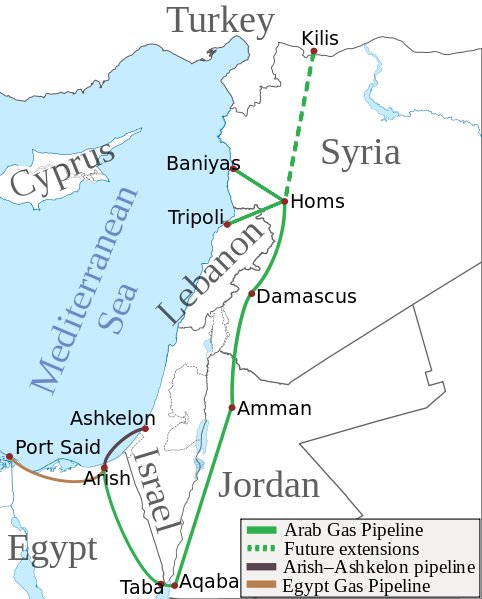
This brings us back to Egypt. The use of the Arab Gas Pipeline is a major strategic goal for both Qatar and the U.S. Access to that pipeline would enable Qatar to supply gas all the way into Syria.arab gas pipeline.png
Depending on who wins the current Syrian Civil war the Arab Gas Pipeline could extend up into Turkey where it would then link up with the South Caucasus Pipeline, the Trans-Anatolian Pipeline, and the Trans Adriatic Pipeline. Qatar’s North Field along with Azerbaijan’s Shah Deniz gas field would pump more natural gas into Europe than Russia does. This puts into perspective why Qatar has been funding the Syrian Opposition with weapons. It also shows why Russia is so adamant that they do not let Assad lose the country.


We’re out of the Cold War and into the Fossil Fuel War. Whoever controls the flow of energy controls the world. Right now the United States is going all in to ensure Qatar is the main supplier of natural gas to the planet. The current crises in Ukraine, the civil war in Syria, and even higher tensions in the South China Sea are all due in some part to this war. A chessboard that saw it’s pieces laid in the early 90’s is nearing its mid-game stage. The conclusion is still far from over.

In the end regardless of whether they tell you that the issue is either human rights, pro democracy, chemical weapons, etc….Everything that happens in the Middle East revolves around energy.

Saturday, February 22, 2014

American Foreign Policy - A Blueprint to Return to the Monroe Doctrine - Part 1


This article kicks off a series on American foreign policy over the next few decades. The United States has entered a period of disengagement. This disengagement should have taken place after WW2, but the emergence of the Soviet Union necessitated a more involved U.S. foreign policy on the “World Island”. Before we take a look at where we’re going it’s important to first look back and see how we got here.


U.S. foreign policy for the framers was pretty easy to define. Two quotes come to mind:


“It is our true policy to steer clear of permanent alliance with any portion of the foreign world"                                                           
                                                                                    George Washington


"Peace, commerce, and honest friendship with all nations-entangling alliances with none."
                                                                                            Thomas Jefferson


It was quite obvious that those who founded the Republic wanted a clear separation between the old and new world.
Fast forward to December 2nd 1823. President James Monroe would deliver his seventh annual State of the Union address to Congress. The contents of this speech would be dubbed the “Monroe Doctrine”. The United States declared political sovereignty over all of the Americas and warned the old world European powers to stay out.
An argument can be made that this was orchestrated by Great Britain in order to secure an economic and political foothold in South America. Whatever the ulterior motives the old world now had to deal with an assertive United States in their sphere of influence. From Monroe’s perspective this would help keep the corruption and age old feuds of Europe out of the Americas. Where as Manifest Destiny would orient the U.S. from east to west the Monroe Doctrine would orient the country north to south. The U.S.’s prosperity would center around the economic and political relationships among the nations of the America’s. A clear separation from the bickering millennia-old rivalries in Eurasia.


In 1918 we had the end of World War 1. With Russia’s exit from the war the threat of German dominance over all of western Europe was too great to ignore. At that moment the United States was forced into the affairs of the old world. It was indeed necessary. One nation in control of all of Europe threatens the balance of the entire planet.
The main problem is that the United States should have disengaged after the end of the war. Instead, Woodrow Wilson took the lead in European affairs and issued his “Fourteen Points” as a basis for a truce. The fourteenth and final point was his globalist ideal for a one world governing body called the League of Nations.We’ll get into the specifics of how Wilson’s Fourteen Points and the Treaty of Versailles can be attributed to much of the current problems in the world today in follow up articles. Right now the main point is that Wilson put us on a course of deeper involvement with the old world. Involvement that our founders warned us about.


WW2 once again showed that the ramifications of one nation attempting to control Eurasia were too critical to ignore. The United States had to intervene despite trying desperately to stay out. A Nazi dominated Eurasia could theoretically dominate the world. The U.S. absolutely did the right thing by entering the war. The problem is that in the devastating aftermath of the war we could not disengage. The Soviet Union now stood on top of the ashes that Hitler wanted to control. Hitler fell but Stalin was right there to pick up the pieces. The threat of one nation controlling Eurasia was still in play.We had fought WW2 to stop Germany from dominating Eurasia. We would now fight the Cold War to stop the Soviet Union from doing the same.


As mentioned before, the U.S. was on a course of orienting from East to West and then North to South on the American continent. However, two catastrophic wars set off a series of moves that would distract American foreign policy up until the present day.
We should have disengaged after the Soviet Union fell in 1991. Instead we remained upon occupied territories, and continued the cold war strategy of spreading democracy throughout the world in order to undermine foreign governments.

This series will focus on providing a blueprint to return to the Monroe Doctrine. To continue our plans to orient North to South on the American continent.